
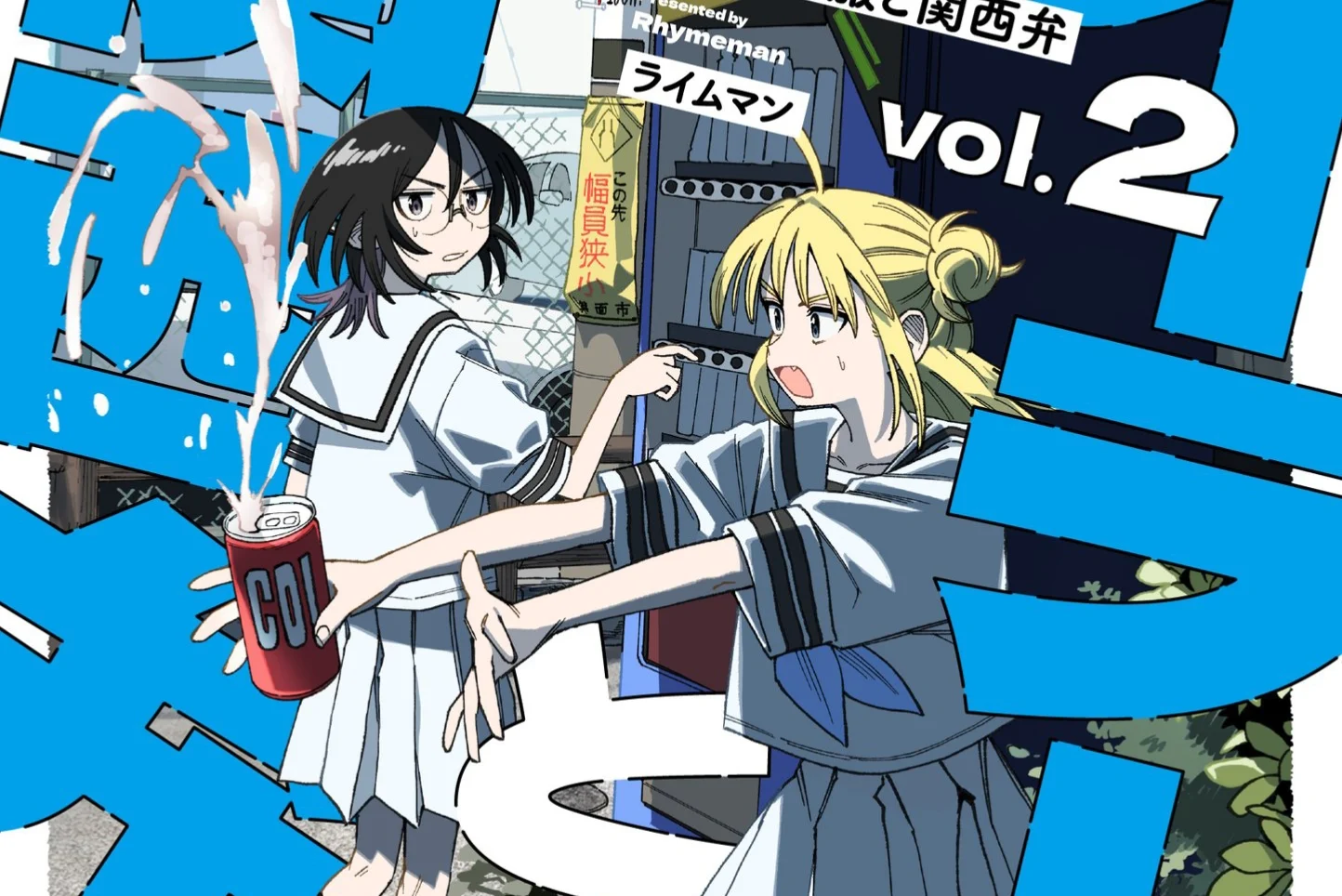
Sailor Suit & Kansai Dialect is preparing to enter its second collected volume. Rhymeman's four-panel comedy will release Volume 2 on October 27, 2026, and Manga Time Kirara has now unveiled a new cover that once again makes Minoh, Osaka part of the artwork.
The new book continues to follow Kaoru Shinonome and Matsuri Hiwatari, two girls from Kawachinagano in southern Osaka who attend high school in Minoh on the northern side of the prefecture. Differences in dialect, local culture, humor and assumptions about what “Osaka” looks like remain central to the series, while Volume 2 expands their daily lives into a part-time job at a maid cafe in Nipponbashi.
Quick Summary
- Japanese title: セーラー服と関西弁
- English text on the cover: Sailor suit & Kansai dialect
- Romanization: Sera-fuku to Kansai-ben
- Author: Rhymeman / ライムマン
- Publisher: Houbunsha
- Imprint: Manga Time KR Comics
- Magazine: Manga Time Kirara MAX
- Format: four-panel manga
- Primary genre: comedy
- Primary genre: school life
- Primary genre: slice of life
- Core characteristic: dialogue is heavily built around Kansai dialect
- Latest volume: Volume 2
- Release date: October 27, 2026
- Book format: A5
- Page count: 120 pages
- Physical price: 1,210 yen including tax
- Pre-tax price: 1,100 yen
- ISBN-13: 978-4-8322-9761-6
- ISBN-10: 4-8322-9761-9
- Volume 2 cover: revealed
- Cover: features Kaoru and Matsuri
- Cover setting: around Minoh, Osaka
- Exact cover location: unannounced
- Kirara editorial prompt: asks Osaka readers if they recognize the location
- Protagonist: Kaoru Shinonome / 東雲薫
- Protagonist: Matsuri Hiwatari / 日渡まつり
- Their hometown: Kawachinagano / 河内長野
- Home region: southern Osaka
- Cultural area: Minamikawachi
- High school: located in Minoh
- School region: northern Osaka
- Premise: two girls from southern Osaka discover cultural and dialect differences after attending school in northern Osaka
- Initial school impression: they are mistaken for delinquents
- Comedy theme: regional differences inside a single prefecture
- Comedy theme: boke and tsukkomi
- Comedy theme: everyday Kansai conversation
- Friend character: Roran Momose / 桃瀬楼蘭
- Volume 2: continues their high-school life
- Volume 2: includes a part-time maid cafe thread
- Maid cafe location: Nipponbashi, Osaka
- Volume 1: released August 27, 2025
- Volume 1: 120 pages
- Volume 1: A5 format
- Volume 1 price: 1,100 yen
- Volume 1 ISBN: 978-4-8322-9658-9
- Series origin: began with guest appearances in Manga Time Kirara MAX
- Regular serialization: began in the issue released October 19, 2024
- Current status: ongoing
- 4-koma of the Year 2025: Volume 1 ranked first in the new-title category
- Digital Volume 2: listings are already appearing on ebook platforms
- Volume 2 status: upcoming, with preorders open
Volume 2 Cover and the Osaka Setting
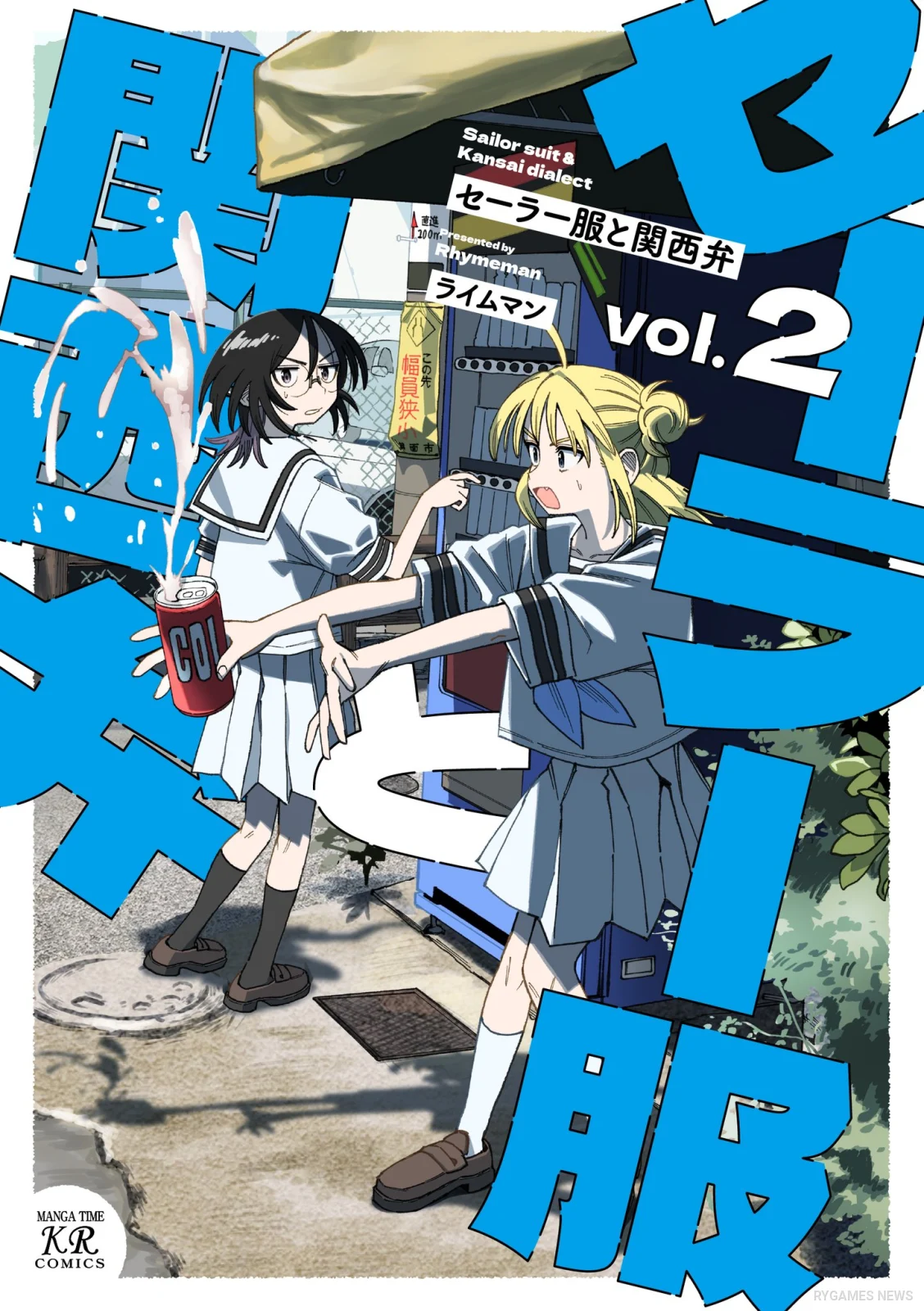
The New Cover Returns to the Minoh Area
Volume 2 preserves one of the visual ideas that fits this manga particularly well: its characters are not placed against an anonymous city backdrop, but in an Osaka environment that looks like part of their actual everyday lives.
Kaoru and Matsuri stand in front of an urban scene described by the Manga Time Kirara editorial account as being somewhere around Minoh, Osaka.
The editors even turned the location into a small challenge for readers, asking people living in Osaka whether they could identify the place illustrated behind the two girls.
No street name, intersection, shop or exact point had been revealed when the cover announcement was published.
It is therefore more accurate to describe the image as depicting the Minoh area rather than matching the artwork to a specific real location based only on storefronts or building facades.
That choice is also consistent with the manga's basic concept.
Minoh is not just a place name that appears once in a synopsis. It shapes Kaoru and Matsuri's school life.
The two are from another part of Osaka and experience the northern side of the prefecture as people who are still technically “local,” yet notice substantial differences in ordinary behavior and language.
In that sense, even a city background becomes part of the comedy's worldbuilding.
From Kawachinagano to Minoh: Still Osaka, but Not Quite the Same Osaka
The central idea behind Sailor Suit & Kansai Dialect is simple: Osaka is not culturally uniform.
Kaoru and Matsuri grew up in Kawachinagano, in the southern Osaka area associated with Minamikawachi.
When they enter high school in Minoh, they encounter a community whose speech and everyday habits do not perfectly match what they assumed “normal Osaka” would be.
That difference becomes the manga's primary source of humor.
It is not a journey across countries or even across prefectures.
The move from southern Osaka to northern Osaka is enough.
Comic Natalie described the series as a regional-culture-gap four-panel comedy about girls from southern Osaka attending school in the north.
Kaoru and Matsuri initially do not realize how distinctive their hometown environment was.
Their speech, behavior and general attitude lead new classmates to assume they are more delinquent than they actually are.
They try to act more refined, attempt to fit into the class, and inevitably return to the boke-and-tsukkomi rhythm that defines their conversations.
That internal Osaka contrast is what makes the title work: the sailor uniform structures their school life, while Kansai dialect shapes both characterization and punchlines.
Kaoru and Matsuri Build Their School Life Through Boke and Tsukkomi
The two protagonists are not simply paired because they share a hometown.
Their chemistry is built through conversation.
They answer each other's remarks, turn small incidents into jokes, and repeatedly transform ordinary situations into exchanges of boke and tsukkomi.
Manga Time Kirara has promoted the series from the beginning as an all-Kansai-dialect daily four-panel manga, giving it a rhythm distinct from school comedies written almost entirely in standard Japanese.
Language is not decoration here.
The dialect affects comedic timing, reveals closeness between characters, and changes how classmates interpret Kaoru and Matsuri.
As the serialization continues, their social circle expands.
One important character is Roran Momose, a classmate who becomes part of their regular high-school routine.
Adding more characters lets the manga grow beyond the simple structure of “two girls from the south versus everyone in the north.”
It becomes a wider school-life ensemble with individual personalities and speech patterns.
Even so, Kaoru and Matsuri remain at the center.
They carry habits from Kawachinagano into Minoh and gradually build a new routine without losing the way of speaking that made them stand out from their first day.
Volume 2 Expands Their Daily Life Into a Nipponbashi Maid Cafe
The official Volume 2 synopsis gives one particularly clear development beyond the first book.
Kaoru and Matsuri are still navigating school life in Minoh, but the story is no longer restricted to classrooms and the trip to school.
The publisher specifically mentions a part-time job at a maid cafe in Nipponbashi.
Nipponbashi is one of Osaka's best-known areas for electronics, anime, games, hobby stores and otaku culture.
For a manga already using real geography as a major source of comedy, moving part of its daily life there naturally expands the series' “map of Osaka.”
Volume 1 centered much of its cultural contrast on Kawachinagano and the new school in Minoh.
Volume 2 gives the characters more reasons to move into other parts of the city.
A part-time job also changes the type of comedy available.
At school, Kaoru and Matsuri are dealing with an image problem: they look and sound more delinquent than they really are.
At a maid cafe, they enter a workplace built around service rules, performance personas and customer expectations.
The collision between natural Kansai speech and the stylized language of maid-cafe service creates another comedic arena without abandoning the series' foundation.
Volume 2 Costs More but Keeps the Same 120-Page A5 Format
Physically, Volume 2 follows the basic format established by the first book.


Publisher-supplied data lists the new release as A5 with 120 pages.
The main change is price.
Volume 1 launched on August 27, 2025 for 1,100 yen, while Volume 2 is priced at 1,210 yen including tax.
Its ISBN is 978-4-8322-9761-6.
Japanese retailers and bibliographic databases are already accepting reservations ahead of October 27.
An ebook edition of Volume 2 has also appeared on Google Play Books and other Japanese digital stores, although regional availability can vary.
The gap between Volumes 1 and 2 is longer than the three- or four-month rhythm sometimes associated with four-panel manga.
The serialization nevertheless continued in Manga Time Kirara MAX during that period, and Rhymeman previously noted that one of the 2026 chapters would be the final installment collected in Volume 2 before taking a break for tankobon work.
The second book therefore serves as the next collected stage of a series that has continued to develop for more than a year since Volume 1.
From Guest Manga to a Regular Kirara MAX Serialization
Sailor Suit & Kansai Dialect did not begin immediately as a regular serialization.
Rhymeman first introduced Kaoru and Matsuri through guest chapters in Manga Time Kirara MAX.
One of the early guest installments showed the pair starting high school with the assumption that their new environment would resemble the delinquent-heavy surroundings they knew back home, only to find Minoh unexpectedly different.
The guest run was well received enough for Houbunsha to promote it into a regular series.
Regular serialization officially began in the December 2024 issue of Manga Time Kirara MAX, released on October 19, 2024.
From there, the manga expanded from one regional-culture-gap premise into a broader school-life comedy.
Later chapters introduced classmates, teachers, part-time work, festivals, exams, arcades and additional Osaka locations.
In August 2025, several early chapters were also made available for free ahead of the first tankobon.
Volume 1 followed on August 27, 2025.
Its progression from guest work to full serialization and now Volume 2 suggests that the appeal reaches beyond the simple novelty of “characters speaking Kansai dialect.”
The local detail continues to give the cast new situations to work with.
Local Identity Is the Core Appeal, Not Just a Character Gimmick
Plenty of manga use dialect to make one character sound distinctive.
Sailor Suit & Kansai Dialect builds almost the entire series around a broader idea.
The point is not merely pronunciation.
It is how two areas inside one prefecture can carry different assumptions, language habits and social rhythms.
Minoh and Kawachinagano provide the first two points of comparison.
Nipponbashi expands the map.
Real locations keep the comedy geographically grounded, but the manga does not become a travel guide.
Kaoru, Matsuri and the people around them remain the focus.
Because the setting is integrated into dialogue, readers encounter details about Osaka through jokes, misunderstandings, school routines and ordinary activities.
The Volume 2 cover is a neat summary of that approach.
Rather than placing its protagonists in an empty design space, the manga brings them back into the streets that make up their everyday world—and even asks local readers whether they recognize the place.
Why This Matters
1) The cover preserves the series' connection to real locations
Minoh is not only part of the synopsis; the area returns as a visual component of Volume 2 itself.
2) The comedy explores differences within Osaka
Moving from Kawachinagano to Minoh is enough to create culture shock without Kaoru and Matsuri ever leaving Osaka Prefecture.
3) Volume 2 expands the everyday map into Nipponbashi
The maid cafe adds a new stage for character comedy while bringing another recognizable Osaka district into the story.
4) Kansai dialect functions as a comedy system rather than decoration
Boke, tsukkomi, conversational timing and social misunderstandings all grow out of how the characters speak.
Sailor Suit & Kansai Dialect Manga Information
For now, the additional important information currently known includes:
- the Japanese title is 『セーラー服と関西弁』
- the cover carries the English text “Sailor suit & Kansai dialect”
- this article uses Sera-fuku to Kansai-ben as its romanization
- the manga is created by Rhymeman
- the author's Japanese name is ライムマン
- it is published by Houbunsha
- it runs in Manga Time Kirara MAX
- collected volumes use the Manga Time KR Comics imprint
- the primary format is four-panel manga
- the series focuses on comedy and school life
- Kansai-dialect dialogue is one of its defining features
- Kaoru Shinonome is one of the protagonists
- Matsuri Hiwatari is the other protagonist
- both are originally from Kawachinagano
- Kawachinagano is in southern Osaka
- their initial cultural context is Minamikawachi
- both attend school in Minoh
- Minoh is in northern Osaka
- internal Osaka culture gaps drive much of the comedy
- both were initially perceived as delinquent-like at their new school
- Roran Momose later becomes one of their close classmates
- the project began with guest chapters before full serialization
- regular serialization began in October 2024
- Volume 1 launched August 27, 2025
- Volume 1 is A5 format
- Volume 1 contains 120 pages
- Volume 1 costs 1,100 yen
- Volume 1 ISBN is 978-4-8322-9658-9
- Volume 2 launches October 27, 2026
- Volume 2 is also A5 format
- Volume 2 contains 120 pages
- Volume 2 costs 1,210 yen
- Volume 2 ISBN is 978-4-8322-9761-6
- Volume 2 ISBN-10 is 4832297619
- the Volume 2 cover has been unveiled
- the cover again uses scenery around Minoh
- the exact location shown has not been officially named
- Manga Time Kirara asked Osaka readers to identify the location
- the Volume 2 synopsis continues to emphasize the Kawachinagano-Minoh cultural contrast
- Volume 2 also includes activity around a Nipponbashi maid cafe
- Nipponbashi is the Osaka district intended by the synopsis
- a digital Volume 2 listing is already live on Google Play Books
- multiple Japanese retailers have opened preorders
- 4-koma of the Year 2025 ranked Volume 1 first in its new-title category
- the series remains ongoing in Manga Time Kirara MAX
- no verified anime adaptation announcement has been made
- new comic information is available through the Manga Time Kirara Official Website
- editorial updates are available through Manga Time Kirara Official X
- author updates are available through Rhymeman Official X
- publisher catalog information is available through Houbunsha
- Volume 2 is listed through Google Play Books
Closing
Sailor Suit & Kansai Dialect Volume 2 continues what makes Rhymeman's manga distinctive: Kansai conversation, local differences within Osaka, and a high-school life consistently tied to real places around its characters. The new Minoh-area cover is a natural extension of that identity.
The 120-page A5 book will be released on October 27 for 1,210 yen. The exact location depicted on the cover has not yet been identified by the editors, while the contents of Volume 2 will push Kaoru and Matsuri's everyday lives beyond school and into a maid cafe in Nipponbashi.
- Manga Time Kirara Official Website — Official October 2026 Comics Schedule Listing Sailor Suit & Kansai Dialect Volume 2
- Hanmoto.com — Publisher-Supplied Volume 2 Format, Page Count, Price, ISBN, Release Date, and Synopsis
- Rakuten Books — Volume 2 Bibliographic Data, 120-Page Count, Price, and Official JPRO Synopsis
- Houbunsha — Official Volume 1 Release Date, Price, and Series Synopsis
- Comic Natalie — October 2024 Report on the Regular Serialization Launch and Regional Culture-Gap Premise
- Google Play Books — Official Digital Listing for Sailor Suit & Kansai Dialect Volume 2
- Manga Time Kirara Editorial Department / X — Official Editorial Account Publishing Series and Volume Updates
- 4-koma of the Year — 2025 New Title Category Result for Sailor Suit & Kansai Dialect Volume 1