
Cygames has offered a detailed look at how Umamusume: Pretty Derby handles character voices in English. The localization-focused CEDEC2026 session was presented on July 24 by English translator Allison Cottrell and English coordinator Ryohei Morita, both members of Cygames' Localization Department.
Rather than assigning every Japanese dialect a straightforward regional English equivalent, the team says its work is built around two ideas: Recognizability and Authenticity. The goal is for an English-speaking player to recognize a character through the way she talks while keeping that voice believable within the target language.
Quick Summary
- Game: Umamusume: Pretty Derby
- Developer / Publisher: Cygames
- Topic: English localization
- Event: CEDEC2026
- Session date: July 24, 2026
- Venue: Pacifico Yokohama North / online
- Format: Short session
- Length: 25 minutes
- Speaker: Allison Cottrell
- Role: English Translator, Cygames Localization Department
- Speaker: Ryohei Morita
- Role: English Coordinator, Cygames Localization Department
- English slides published online: August 2026
- Core subjects: Dialects, unique speech, personality, and consistency
- Guiding ideas: Recognizability and Authenticity
- Tamamo Cross: Kansai speech was not simply mapped to a Southern American accent
- Reason: Taiki Shuttle already carries a distinctly American identity
- Tamamo solution: Spelling, rhythm, pacing, and dialogue shape
- Yukino Bijin: Uses deliberately older-feeling English vocabulary and slang
- Reference period: Roughly the 1930s through 1960s
- Agnes Digital: Draws on real English-language otaku and fandom expressions
- Daitaku Helios: Gyaru culture is represented through a Gen Z parallel
- Example slang: “Let her cook”
- Helios goal: Preserve her fast, chaotic, social, slang-heavy personality
- Task assignment: Translators with relevant character or subculture knowledge can take the lead
- Internal communication: Slack
- Expression developed through discussion: “Umazing!”
- Documentation: Character speech guidelines and style guides
- Quality process: Guidelines are checked by the language quality team
- Main purpose: Keep character voices consistent even when translators change
- Important distinction: Cygames did not say all of Umamusume was rewritten “for Gen Z”
- Gen Z: A specific localization solution for Daitaku Helios
- Merry Christmas → Happy Holidays: Not a case study in this CEDEC presentation
- Mihono Bourbon Master → Trainer: Not a case study in this CEDEC presentation
- Claims of broadly toning down romance: Not explained as part of this presentation
CEDEC2026 Presentation and Localization Slides
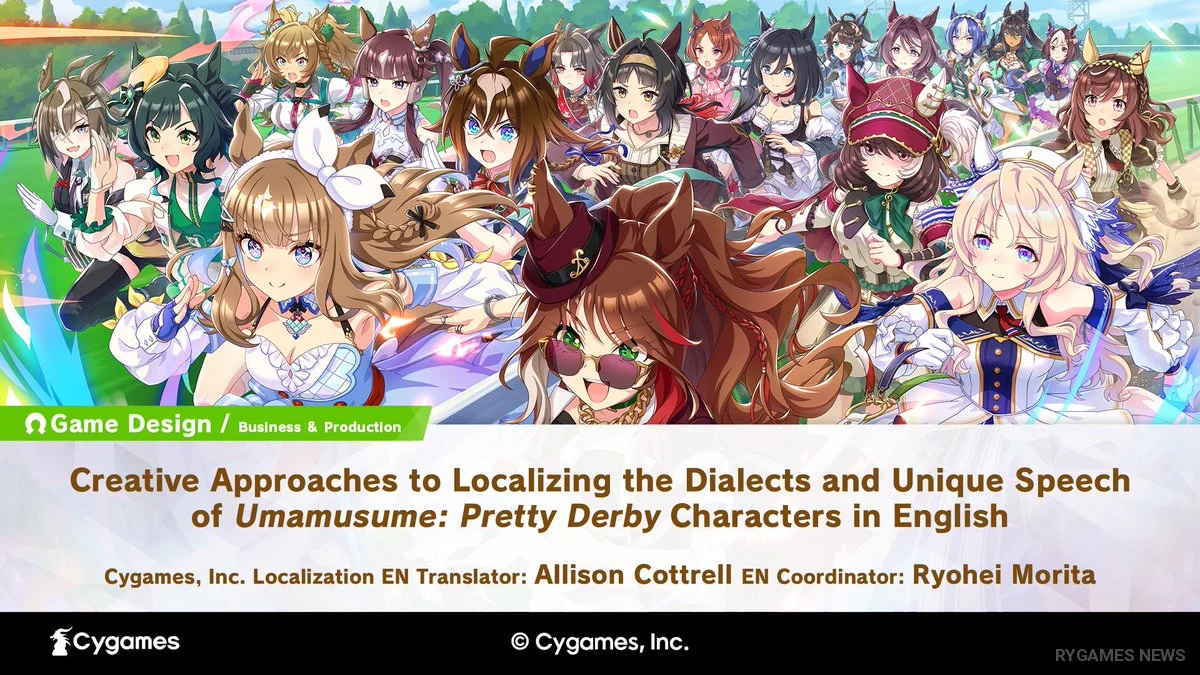
Japanese Dialects Are Not Automatically Replaced With Western Accents
One of the fundamental problems facing Umamusume's English team is that many characters do not speak standard Japanese.
Regional dialect, word choice, pronouns, sentence endings, speed, and levels of politeness all contribute to characterization.
Cygames argues that the familiar localization shortcut of pairing one Japanese dialect with one recognizable English-language region does not always work.
Tamamo Cross is one of its examples. Kansai speech could theoretically be represented through something like Southern American English, a commonly recognizable way of marking dialect in localization.
The problem is that Umamusume already includes Taiki Shuttle, whose characterization is directly connected to the United States. Giving Tamamo an equally specific American regional identity could blur two very different character backgrounds.
The team instead places more weight on rhythm, clipped words, altered spelling, and pacing.
The point is not to tell English players that Kansai is equivalent to a particular part of America. It is to make Tamamo's lines visibly and rhythmically distinct from standard dialogue.
Yukino Bijin Sounds Old-Fashioned Instead of Being Assigned a Western Region
Yukino Bijin created a different challenge.
She comes from Iwate and retains a rural, hometown quality in the way she speaks.
Rather than turning her into a direct stand-in for a particular rural community in the United States or Britain, Cygames approached the difference through word choice.
The localization draws on some English vocabulary and slang associated with the 1930s through 1960s, giving her voice a slightly old-fashioned quality next to more contemporary speakers.
That choice attempts to communicate distance from modern urban speech without assigning her a Western identity that does not exist in the source.
It also demonstrates why Cygames does not use one universal solution for Japanese dialects. Tamamo's difference may be communicated visually through spelling and rhythm, while Yukino's is carried more strongly through vocabulary.
Agnes Digital Pulls From English-Speaking Otaku Culture
With Agnes Digital, regional dialect is not the main issue. Subculture is.
Digital's Japanese speech is packed with the kind of excitement and expressions associated with passionate otaku fandom.
Simply making the English dialogue louder or more energetic would not reproduce that identity.
The team instead looked at how English-speaking anime fans and online fandom communities actually express extreme excitement over favorite characters.
Those patterns became part of Digital's English voice.
Cygames frames this under Authenticity: not literal word-for-word equivalence, but a target-language voice that English readers can recognize as belonging to someone deeply immersed in fandom culture.
The production workflow supports that goal by assigning characters to translators whose interests or knowledge are particularly useful for the voice being written.
Daitaku Helios Uses Gen Z as a Parallel for Gyaru Culture
The part of the deck now circulating most widely online concerns Daitaku Helios.
In Japanese, Helios makes heavy use of gyaru language, including slang, abbreviations, fashionable expressions, and an extremely social style of communication.
Cygames' slide identifies a problem: gyaru culture is not necessarily well understood by players outside Japan.
The team therefore looked for a parallel culture whose language could serve a similar communicative function in English and settled on Gen Z.
That led to the use of contemporary internet slang. One example discussed in the session is “Let her cook,” a phrase used to encourage someone to continue because whatever they are doing or saying may be going somewhere worthwhile.
The localization also tries to retain Helios's distinctive social energy: quick, extremely friendly, slang-heavy, and occasionally intense enough to leave other people momentarily processing what she just said.
The scope is important, however. The presentation does not say that the entire English version of Umamusume was redesigned for Gen Z.
Gen Z is presented as a specific localization strategy for conveying the social function of Daitaku Helios's gyaru speech.
“Umazing!” Came Out of the Team's Slack Discussions
The CEDEC talk also explains how Cygames tries to preserve those decisions across a game with a large cast and multiple translators.
Assignments can take a translator's interests and knowledge into account.
Someone already familiar with otaku language, for example, may be a better first choice for Agnes Digital than a colleague who has little exposure to that community.
The localization team also uses Slack for brainstorming rather than restricting discussion to formal task reports.
Casual suggestions can be shared, tested, and refined by the group.
One expression highlighted during the session is “Umazing!”, a play on “Uma” and “amazing” that became recognizable among global players.
Once a character's voice is established, that knowledge is documented instead of remaining with one translator.
Cygames creates speech guidelines and style guides, which are then reviewed through language quality processes so another member can reproduce the same voice later.
Viral Posts Mix the CEDEC Talk With Separate Localization Debates
As Cygames' slides have circulated again, some social media posts have combined the presentation with older debates surrounding individual English localization choices.
Examples frequently mentioned include “Merry Christmas” becoming “Happy Holidays,” Mihono Bourbon's “Master” becoming “Trainer,” and claims that romantic material has been broadly softened.
The key distinction is that those three points are not case studies in this CEDEC2026 presentation.
The official deck centers on Tamamo Cross, Yukino Bijin, Agnes Digital, Daitaku Helios, team assignments, internal communication, and character documentation.
Other English-text differences can be examined separately, but their motives cannot automatically be inferred from the Helios slides or from the broader localization philosophy discussed at CEDEC.
Accordingly, describing this presentation as Cygames admitting that it “removed Christmas” or “censored romance” would merge separate issues into a claim the session itself did not make.
What Cygames actually presented here is its method for recreating distinctive character voices when Japanese dialect and subcultural speech do not have direct English equivalents.
Why This Matters
1) Localization is being treated as part of character design
The team is not only checking whether the basic information in a sentence survives. Rhythm, slang, word choice, and social background are treated as part of a character's identity.
2) Japanese dialects are not automatically mapped to Western geography
Tamamo Cross demonstrates an attempt to avoid the formula of “Japanese region equals American region,” particularly when it would conflict with another character's background.
3) Daitaku Helios is a clear example of cultural substitution
Gyaru and Gen Z are not the same culture. Cygames instead uses the latter as a target-culture analogue intended to reproduce the social energy and linguistic function of the former.
4) Consistency is built into the workflow
Character assignments, Slack discussions, speech guidelines, and language quality review are meant to keep a voice stable even when a different translator takes over later.
Game and Localization Information
Additional confirmed information includes:
- Umamusume: Pretty Derby is developed and published by Cygames
- the English version is supported by an internal Cygames localization team
- the CEDEC2026 session took place on July 24, 2026
- it was categorized under Game Design with storytelling and localization themes
- Allison Cottrell and Ryohei Morita presented the session
- Cottrell is an English Translator in Cygames' Localization Department
- Morita is an English Coordinator
- Recognizability and Authenticity are the two core concepts highlighted by the session
- Tamamo Cross relies on spelling and rhythm rather than one direct geographic accent
- Yukino Bijin uses deliberately older-feeling English expressions
- Agnes Digital draws from English-language fandom and otaku culture
- Daitaku Helios uses Gen Z as a parallel culture for gyaru
- “Let her cook” is one of the slang examples discussed
- character assignments can reflect team members' interests and expertise
- Slack is used for localization brainstorming
- “Umazing!” is highlighted as one expression that emerged from internal discussion
- speech and style guidelines are used for consistency
- the language quality team reviews those guidelines
- English-language slides were shared online after CEDEC2026
- official global information is available through the Umamusume: Pretty Derby website
- the PC version is available through Umamusume: Pretty Derby on Steam
- the official session description is available from CEDEC2026
- the full English deck is available through Cygames on Speaker Deck


Closing
Cygames' CEDEC2026 presentation shows that Umamusume's English localization does not rely on a single formula for unusual Japanese speech. Tamamo Cross leans on spelling and rhythm, Yukino Bijin on older vocabulary, Agnes Digital on fandom language, and Daitaku Helios on Gen Z slang as an analogue for gyaru communication.
The context also matters. Cygames did not say the entire game was rewritten for Gen Z, and several localization controversies now being attached to the presentation were not among its case studies. The actual subject of the session was how to keep strongly differentiated character voices recognizable when moving from Japanese into English.
- Cygames Speaker Deck — Official CEDEC2026 English Presentation on Umamusume Character Dialects and Unique Speech
- Cygames Conference Info X — Official English Slide Release Announcement for the CEDEC2026 Session
- CEDEC2026 — Official Session Description, Speakers, Roles, Localization Goals, and Schedule
- GAME Watch — CEDEC2026 Session Report Covering Tamamo Cross, Yukino Bijin, Agnes Digital, Daitaku Helios, and Team Workflow
- Umamusume: Pretty Derby — Official Global Game Website
- Steam — Official Umamusume: Pretty Derby PC Store Page and Game Information