

Plan B: Terraform is expanding on September 23, 2026 with Worlds of Fire and Water, a new DLC from Gaddy Games built around two planets at environmental extremes. One is an intensely hot volcanic world shaped by lava; the other is almost completely submerged beneath an ocean.
The DLC arrives alongside a substantial free Update 1.1 for all base-game owners. While the two new planets are paid content, most of the new mechanics and items—including the technology tree, vehicle upgrades, dynamic ice caps, orbital tools, new transport options, and ocean ecosystems—will be available without purchasing the expansion.
Quick Summary
- DLC: Plan B: Terraform - Worlds of Fire and Water
- Base game: Plan B: Terraform
- Format: Downloadable content / expansion
- Developer: Gaddy Games
- Publisher: Gaddy Games
- Release date: September 23, 2026
- Platform: PC via Steam
- Announced DLC price: US$5
- Base game required: Yes
- Mode: Single-player
- Steam genres: Indie, Simulation, Strategy
- New planets: Fire World and Water World
- Fire World: Extreme heat, constant eruptions, mineral-rich basalt, geysers, and scarce water
- Water World: An ocean-covered world with only a handful of small islands
- Water World challenge: Lower sea levels, remove mineral pollution, and develop an ocean ecosystem
- Free update: Version 1.1
- Update 1.1 date: September 23, 2026
- Tech Tree: Replaces level-based progression
- Transport upgrades: Trucks, train wagons, and drones can increase carrying capacity
- Fat Train: Unlocks trains with four containers per wagon
- Dynamic ice caps: Ice thickness responds to global temperature
- Terraforming additions: Shade satellites, mirror satellites, ice comets, and GHG neutralisation
- Ocean ecosystem: Sea plants and plankton
- Food production: Water Farm
- New transport: Small Ship and Airship
- New extraction: Drone Extractor and Floating Extractor
- Old saves: Remain playable
- Developer recommendation: Start a new world for Update 1.1
- Version 1.0: Will remain accessible through a dedicated Steam branch
- Languages: 16 interface languages
- Steam Workshop: Supported
- Steam Cloud: Supported
- Family Sharing: Supported
- Minimum RAM: 4 GB
- DLC storage requirement: 500 MB
Trailer, Steam DLC, and Worlds of Fire and Water Visual
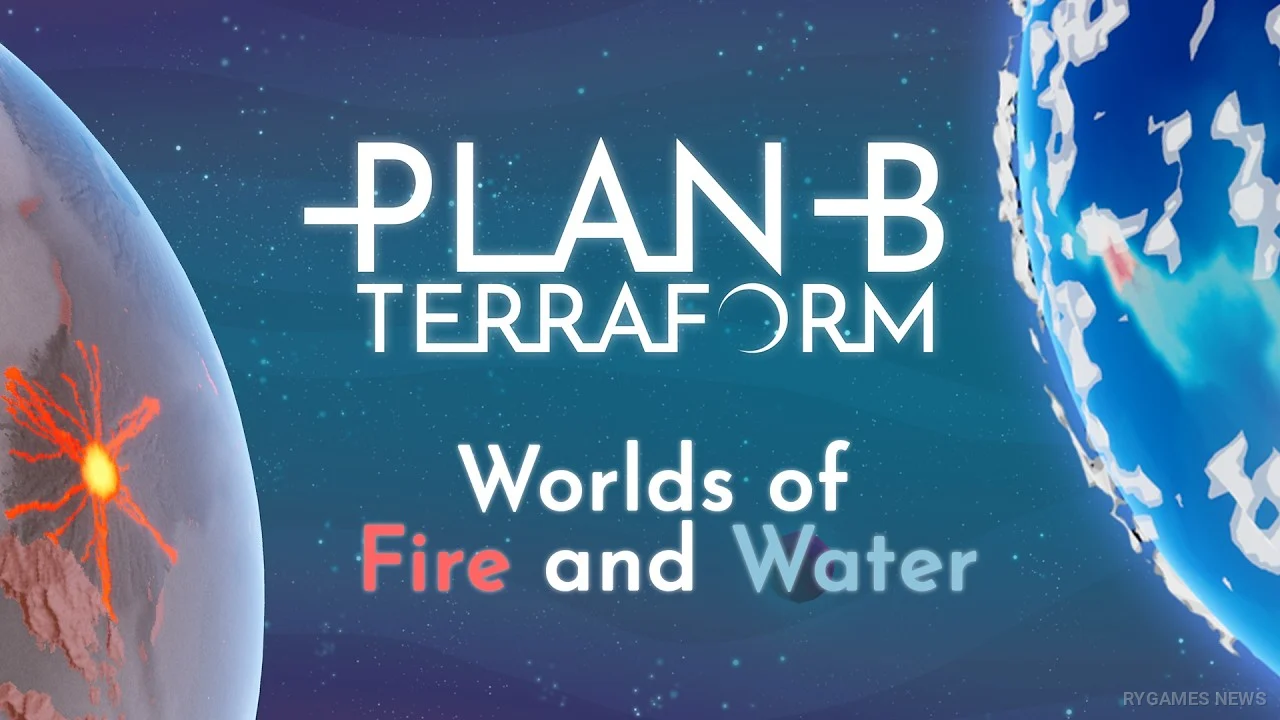
Fire World Turns Lava Into Both a Threat and a Resource
Fire World begins at an extreme temperature and is constantly reshaped by volcanic eruptions. Infrastructure must therefore coexist with an environment that is actively capable of disrupting the player's expansion.
Traditional mineral deposits are largely absent. Instead, cooling lava produces mineral-rich basalt, turning one of the planet's greatest hazards into its primary source of extractable material.
The lava itself is fully simulated according to Gaddy Games, giving players an opportunity to use terraforming tools to influence its behavior and protect valuable infrastructure.
Water is another major constraint. Only a few geysers are initially available, but later progression allows rockets to deliver ice comets, dramatically increasing the amount of liquid water available for terraforming.
Water World Makes Dry Land a Resource of Its Own
Water World presents the opposite problem. Oceans dominate nearly the entire planet, leaving only a handful of islands on which to establish the first settlements and industries.
Cooling the world expands its ice caps, trapping more water in frozen form and lowering sea levels. New stretches of dry land gradually emerge as a direct consequence of climate management.
Players can also use dams and terrain manipulation to claim additional building space, making geography itself part of the progression loop.
Minerals create another complication. Ocean water becomes polluted after contacting the seabed, but filters can recover those minerals while cleaning sections of the water.
Clean water allows sea plants to spread, which helps plankton develop. Plankton then contributes to oxygen production, making the marine ecosystem an active component of terraforming rather than background scenery.
Update 1.1 Replaces Levels with a Technology Tree
The largest progression change arrives for everyone through Update 1.1. The existing level system is replaced by a technology tree, allowing players to choose the order in which many technologies are unlocked.
Cities also become more directly connected to technological progress. Higher population increases the rate at which tech points are generated.
Transport receives its own upgrade system. Trucks, train wagons, and drones can be upgraded to carry two containers instead of one.
The Fat Train upgrade goes further, unlocking a train capable of carrying four containers per wagon. Endless upgrades are also planned for late-game progression.
Climate, Oceans, and Orbit Become More Interactive
Ice caps will become dynamic, increasing or decreasing in thickness as players warm or cool their planets.
The number of climate tools also expands. Shade satellites and mirror satellites provide orbital methods of controlling incoming energy, while ice comets can introduce additional water.
A greenhouse-gas neutralisation facility gives players another way to cool the atmosphere and counter previous warming strategies.
Oceans gain practical value through sea plants, plankton, and Water Farms, while new Small Ships and Airships expand transportation choices.
Long-range Drone Extractors and Floating Extractors further broaden where resources can be collected without relying entirely on conventional land-based infrastructure.
Existing Saves Work, but a Fresh World Is Recommended
Gaddy Games says existing save files will remain compatible with Update 1.1, but the developer strongly recommends beginning a new world.
Dynamic ice caps and a new temperature balance can significantly alter existing terraforming setups. Worlds built around the current climate model may therefore require substantial repairs.


The effectiveness of SF6 and NF3 is also being rebalanced because mirror satellites introduce another method of warming a planet.
Players who would rather preserve the previous simulation can continue using version 1.0 through a dedicated Steam branch, allowing the older ruleset to remain accessible.
Plan B: Terraform Reached Version 1.0 in 2025
Plan B: Terraform originally entered Steam Early Access on February 15, 2023, before reaching version 1.0 on August 29, 2025.
The base game simulates an entire planet across more than one million hexagons, tracking global temperature, vegetation, rainfall, rivers, and oceans while players build increasingly complex industrial networks.
Minerals are extracted and processed into goods, then transported by trucks, trains, drones, and ships to cities that can grow from small settlements into populations numbering in the millions.
Worlds of Fire and Water builds on that foundation by changing the environmental assumptions at the start of a playthrough. Mineral access, water management, and temperature control all function differently depending on the selected world.
Why This Matters
1) Both planets reshape the economy from the opening minutes
Fire World ties mineral extraction to cooling lava, while Water World makes usable land and clean water scarce resources of their own.
2) The paid DLC and free update have clearly different roles
The new planets are the premium content, while most of Update 1.1's mechanics and items will remain available to all owners of the base game.
3) Terraforming is becoming genuinely two-directional
Plan B has traditionally emphasized warming a barren planet. Shade satellites, dynamic ice caps, and Water World make deliberate cooling just as important.
4) Oceans become part of production and logistics
Sea plants, plankton, Water Farms, Small Ships, and Floating Extractors give water a much larger mechanical role.
Game Information
Additional confirmed details include:
- Worlds of Fire and Water launches on September 23, 2026
- the DLC requires the Plan B: Terraform base game
- Gaddy Games has announced a US$5 price
- the DLC is currently available to wishlist on Steam
- free Update 1.1 launches on the same date
- most new Update 1.1 mechanics and items can be used on the classic planet
- Fire World features dynamically simulated lava
- cooled lava creates extractable basalt deposits
- geysers are an early source of water on Fire World
- ice comets can deliver additional water
- Water World begins with very little dry land
- expanding ice caps can lower sea levels
- filters recover minerals while cleaning polluted water
- sea plants and plankton contribute to oxygen production
- the technology tree replaces levels
- city population affects tech-point generation
- transport upgrades and endless late-game upgrades are included
- old saves remain compatible, although a fresh world is recommended
- version 1.0 will remain available through a separate Steam branch
- the DLC supports Steam Achievements, Trading Cards, Workshop, Cloud, and Family Sharing
- Windows 64-bit is required
- minimum memory is 4 GB RAM with 2 GB video memory
- the DLC lists a 500 MB storage requirement
- wishlist the expansion through Worlds of Fire and Water on Steam
- the base game is available through Plan B: Terraform on Steam
- developer information is available from Gaddy Games
Closing
Worlds of Fire and Water expands Plan B: Terraform with more than two new maps. Its planets begin under conditions that fundamentally change how resources, water, terrain, and climate have to be managed.
The DLC launches September 23, 2026 at an announced US$5 price. Free Update 1.1 arrives alongside it with a technology tree, upgrades, dynamic ice caps, orbital terraforming tools, ocean ecosystems, new vehicles, and new extraction systems for every base-game owner.
- GamesPress — DLC Release Date, Fire and Water Worlds, Price, and Free Update Announcement
- Steam Community — Official Worlds of Fire and Water DLC and Update 1.1 Announcement
- Steam — Official Worlds of Fire and Water DLC Page, Features, Languages, and System Requirements
- Steam — Official Plan B: Terraform Base Game Page, Release History, Features, and Languages
- YouTube — Official Plan B: Terraform Worlds of Fire and Water DLC Trailer
- Gaddy Games — Official Developer Website and Plan B: Terraform Information